

Most people who take a Vitamin D supplement are taking the wrong form. The difference between D2 and D3 is not marketing — it is biochemistry, and it has a measurable effect on how much your blood levels actually rise after supplementation.

This article breaks down what the research shows, which form to take, what dose makes sense for most people, and why pairing it with K2 matters.
| Pick | Best For | |
|---|---|---|
| Thorne Vitamin D/K2 Liquid | Overall pick | Check Price |
| NOW Foods Vitamin D3 5000 IU | Best budget D3 | Check Price |
| Jarrow Formulas MK-7 | Best K2 separately | Check Price |
D2 vs D3: what the research shows
Vitamin D2 (ergocalciferol) is derived from plant sources and fungi. Vitamin D3 (cholecalciferol) is derived from animal sources — primarily lanolin from sheep wool — and is the form your skin synthesizes from sunlight.
Multiple randomized controlled trials have compared the two forms head to head. A 2012 meta-analysis published in the American Journal of Clinical Nutrition found that D3 was significantly more effective than D2 at raising and maintaining serum 25(OH)D levels — the standard measure of Vitamin D status in the body. The difference is not small: D3 has been estimated to be roughly 87% more effective at raising blood levels than the equivalent dose of D2.
The reason comes down to how each form is processed. D3 more closely matches the form your body produces naturally and has a longer half-life in the bloodstream.
Why most people are deficient
Vitamin D is produced in the skin when UV-B radiation hits cholesterol. In practice, most people in northern latitudes, people who work indoors, people who wear sunscreen consistently, and people with darker skin tones produce insufficient amounts. The National Institutes of Health estimates that about 42% of American adults are Vitamin D deficient.
Deficiency is associated with impaired immune function, mood disorders, bone loss, and increased risk of respiratory infections. It is one of the few supplementation cases where the evidence for broad benefit is strong even without a confirmed diagnosis.
The case for pairing D3 with K2
Vitamin D increases calcium absorption from the gut. This is its primary mechanism for supporting bone density. The problem is that increased calcium absorption without adequate K2 can lead to calcium depositing in soft tissues rather than being directed to bones.
Vitamin K2 (specifically the MK-7 form) activates proteins that direct calcium into bones and away from arteries. The combination of D3 and K2 is increasingly standard in research and in high-quality supplements. If you are taking D3 at meaningful doses (2000 IU or above), pairing it with K2-MK7 is worth doing.
What dose is right
The official tolerable upper intake level for Vitamin D is 4000 IU per day for adults. Most functional medicine practitioners and researchers consider 2000-5000 IU of D3 daily to be a reasonable maintenance dose for people who are deficient or have limited sun exposure. The only way to know your actual status is a 25(OH)D blood test — aim for levels between 40-60 ng/mL.
Our top picks
Best overall: Thorne Vitamin D/K2 Liquid

Best overall: Thorne Vitamin D/K2 Liquid
Thorne combines D3 with K2-MK7 in a liquid form that allows flexible dosing. NSF Certified for Sport. No soy, dairy, or gluten. The liquid delivery improves absorption compared to some capsule forms. This is our first recommendation for most people.
What we like: D3 plus K2-MK7 in one liquid dose, NSF Certified for Sport, free of soy, dairy, and gluten.
Best budget D3: NOW Foods Vitamin D3 5000 IU
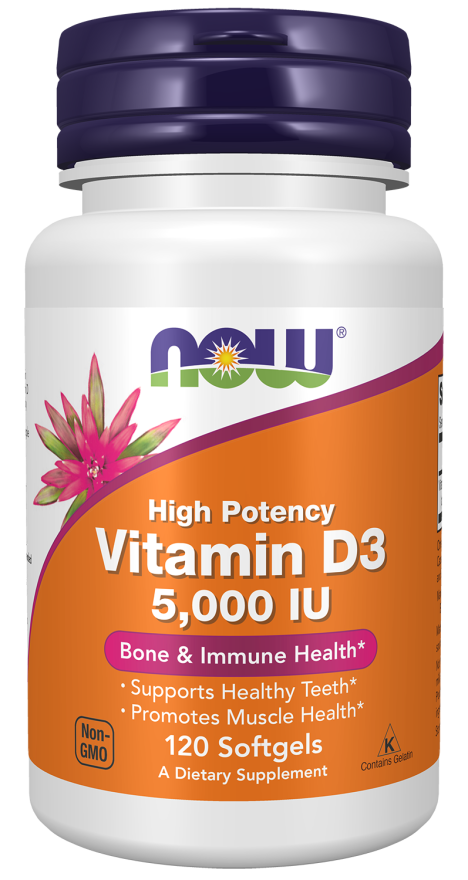
Best budget D3: NOW Foods Vitamin D3 5000 IU
360 softgels in olive oil for under $18. NOW uses cholecalciferol (D3), their products are GMP certified, and they pass regular third-party testing. If you are adding K2 separately, this is a reliable and cost-effective D3 source.
What we like: 360 softgels in olive oil for absorption, GMP certified, regularly third-party tested, under $18.
Best K2 separately: Jarrow Formulas MK-7

Best K2 separately: Jarrow Formulas MK-7
If you prefer to take D3 and K2 in separate supplements for dose flexibility, Jarrow Formulas MK-7 provides 90mcg of menaquinone-7 per capsule — the most bioavailable and longest-acting K2 form.
What we like: 90mcg of menaquinone-7 per capsule, ideal for dosing D3 and K2 separately.
Affiliate disclosure: this article contains affiliate links. We may earn a small commission if you purchase through them at no extra cost to you.
Medical disclaimer: this article is for informational purposes only. Consult a licensed healthcare provider before starting any supplement, especially at higher doses.